

If you’ve been following my earlier posts, you should already have a solid understanding of how the Flame Ionization Detector works. Today, we’re going deeper into something you can apply immediately in your daily analysis — the FID mole response factor. This idea often surprises people because it allows you to quantify peaks without having the pure chemical standard for calibration.
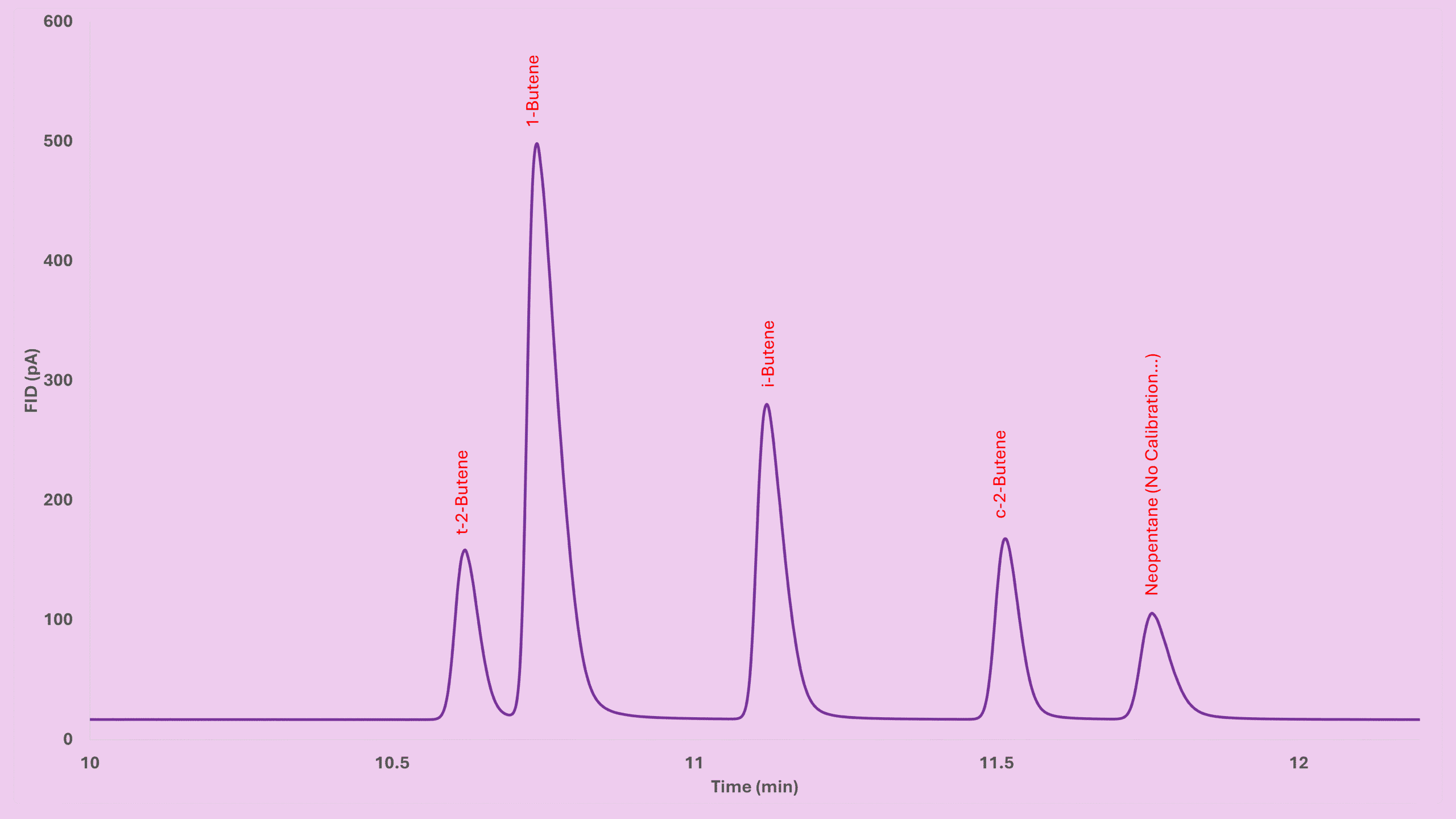
Whenever I introduce this concept, most customers react the same way: “Wait… so I can calculate the response factor for a compound even if I don’t have the standard?”
Exactly — and that’s why this concept is so useful.
Why the FID Mole Response Factor Matters
Imagine running a GC sample with five peaks: A, B, C, D, and E. You can identify and calibrate the first four peaks, but peak E lacks a calibration standard. You know what the compound is, but you simply don’t have the pure chemical to build the response factor.
That’s where the FID mole response factor and relative response factor (RRF) come in.
As long as you know the carbon-based relationship between peak E and a calibrated reference peak (say A), you can calculate the response factor for E. Once you have that, you can quantify it. Based on experience, the calculation gives around 5–10% error, which is much better than leaving peak E unreported.
What Is the FID Mole Response Factor?
Let’s start with the basics. The FID mole response factor is simply the ratio of concentration to FID response.
Although some define it the other way around, this post follows the definition used in Agilent software:
Response Factor (RF)
RF = C / A
Where:
- C = concentration by mole
- A = peak area
Every compound generates its own ion current in the flame, meaning each has its own unique RF.
Understanding How Carbon Controls the FID Response
To understand how RF differs among hydrocarbons, we return to what happens inside the flame.
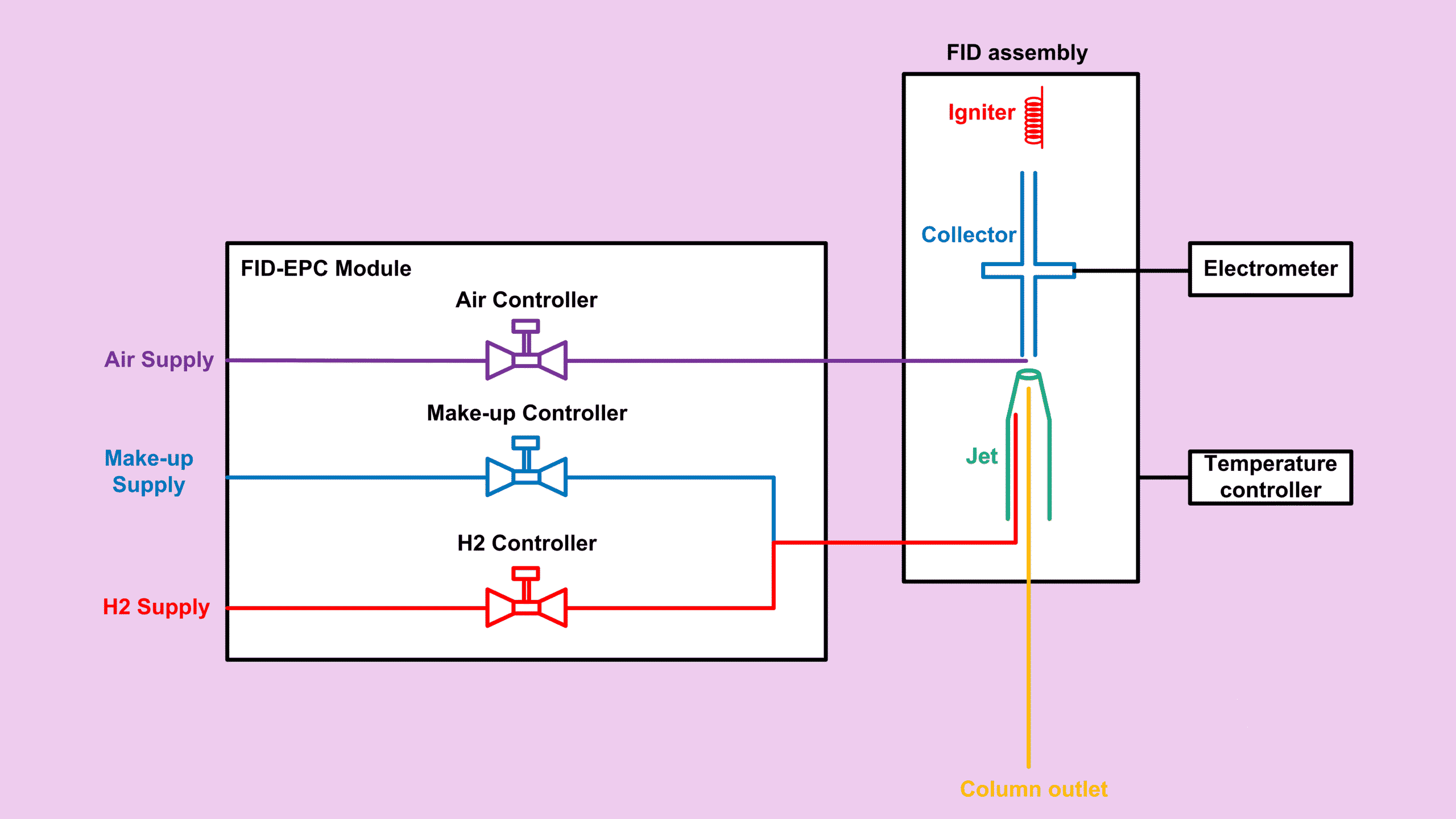
Only a small portion of each hydrocarbon burns into CHO⁺ ions. The general ion formation reaction is:
CxHy + O2 → xCHO+ + e−
What matters most is this simple rule:
1 carbon atom produces 1 CHO⁺ ion
Let’s compare two examples:
CH4 + O2 → CHO+ + e−
C3H8 + O2 → 3CHO+ + e−
Assume both Methane and Propane are present at the same mol% (“x”). Only a tiny fraction (“y”) is burned in the FID flame. From that:
- Methane produces y CHO⁺
- Propane produces 3y CHO⁺
So Propane generates three times the response of Methane — matching their 3:1 carbon ratio.
We can put this into a simple visualization:
"x" mol% Methane → "y" CHO+ → "z" peak area
"x" mol% Propane → "3y" CHO+ → "3z" peak area
This gives:
RF_Methane = x / z
RF_Propane = x / (3z)
Defining the Relative Response Factor (RRF)
The relative response factor compares the RF of two compounds:
RRF(A/B) = RF_A / RF_B
For this blog, Methane will be the reference. So:
RRF(Propane/Methane) = RF_Propane / RF_Methane
Substituting RF values:
RRF = (x/3z) / (x/z)
RRF = 1/3
Other examples follow the same pattern:
RRF(Pentane/Ethane) = 2/5 = 0.4
RRF(Heptane/Butane) = 4/7 = 0.5714
Because this depends solely on carbon count, you can calculate RRF before running the GC, as long as:
- The compounds are pure hydrocarbons
- Concentration is in mole-based units
Why Hydrocarbons Only?
The entire logic works because FID ion formation depends strictly on carbon atoms. Compounds containing oxygen or other heteroatoms break this relationship.
To summarize:
RRF_Mole(i/ref) = C_ref / C_i
Where:
- i = compound of interest
- ref = reference compound
- C = number of carbon atoms
Experimental Evidence Supporting the Theory
You may wonder if this carbon-based logic holds up in real GC data. Fortunately, I’ve collected plenty of experimental datasets over the years. Below is one comparison between:
- Experimental RRF (Propane as reference)
- Theoretical RRF from carbon count
Experimental vs Theoretical RRF Table
| Compound | Conc (mol%) | Peak Area | RF (C/A) | Experimental RRF (Propane Ref) | Carbon | Theoretical RRF | Difference (%) |
|---|---|---|---|---|---|---|---|
| Propane | 0.501 | 251.60 | 0.001991 | 1.0000 | 3 | 1.0000 | 0.0% |
| Isobutane | 0.100 | 67.00 | 0.001493 | 0.7495 | 4 | 0.7500 | -0.1% |
| n-Butane | 0.100 | 67.53 | 0.001481 | 0.7437 | 4 | 0.7500 | -0.8% |
| Isopentane | 0.101 | 84.40 | 0.001197 | 0.6010 | 5 | 0.6000 | 0.2% |
| n-Pentane | 0.101 | 85.15 | 0.001186 | 0.5957 | 5 | 0.6000 | -0.7% |
| Cyclopentane | 0.101 | 82.48 | 0.001225 | 0.6150 | 5 | 0.6000 | 2.5% |
The difference is small, showing how reliable the carbon-based prediction is.
Final Notes Before Applying This
If RF is defined as C/A, then:
RRF_Mole(i/ref) = C_ref / C_i
If RF is defined as A/C instead:
RRF_Mole(i/ref) = C_i / C_ref
And yes — we will cover mass-based and volume-based response factors in upcoming posts.
Key Takeaways
- The FID mole response factor shows how hydrocarbons generate ions proportional to carbon count.
- Relative response factors can be calculated before analysis using carbon ratios.
- This method works only for pure hydrocarbons and mole-based quantities.
- Experimental data closely matches theoretical predictions.
Try the Instant Calculator to Calculate FID mole response factor
A calculator that applies the formulas discussed in this blog post can be found at FID Relative Response Factor Calculator for GAS or FID Relative Response Factor Calculator for LIQUID. Just enter:
- Number of carbon atoms and hydrogen atoms for a reference compound
- Number of carbon atoms and hydrogen atoms for an unknown compound
The result updates automatically — perfect for method development and troubleshooting.
Try This Next
If you’re curious how these relationships change when concentrations are based on mass or volume, be sure to visit the FID series — the next posts in this series will dive into those topics.