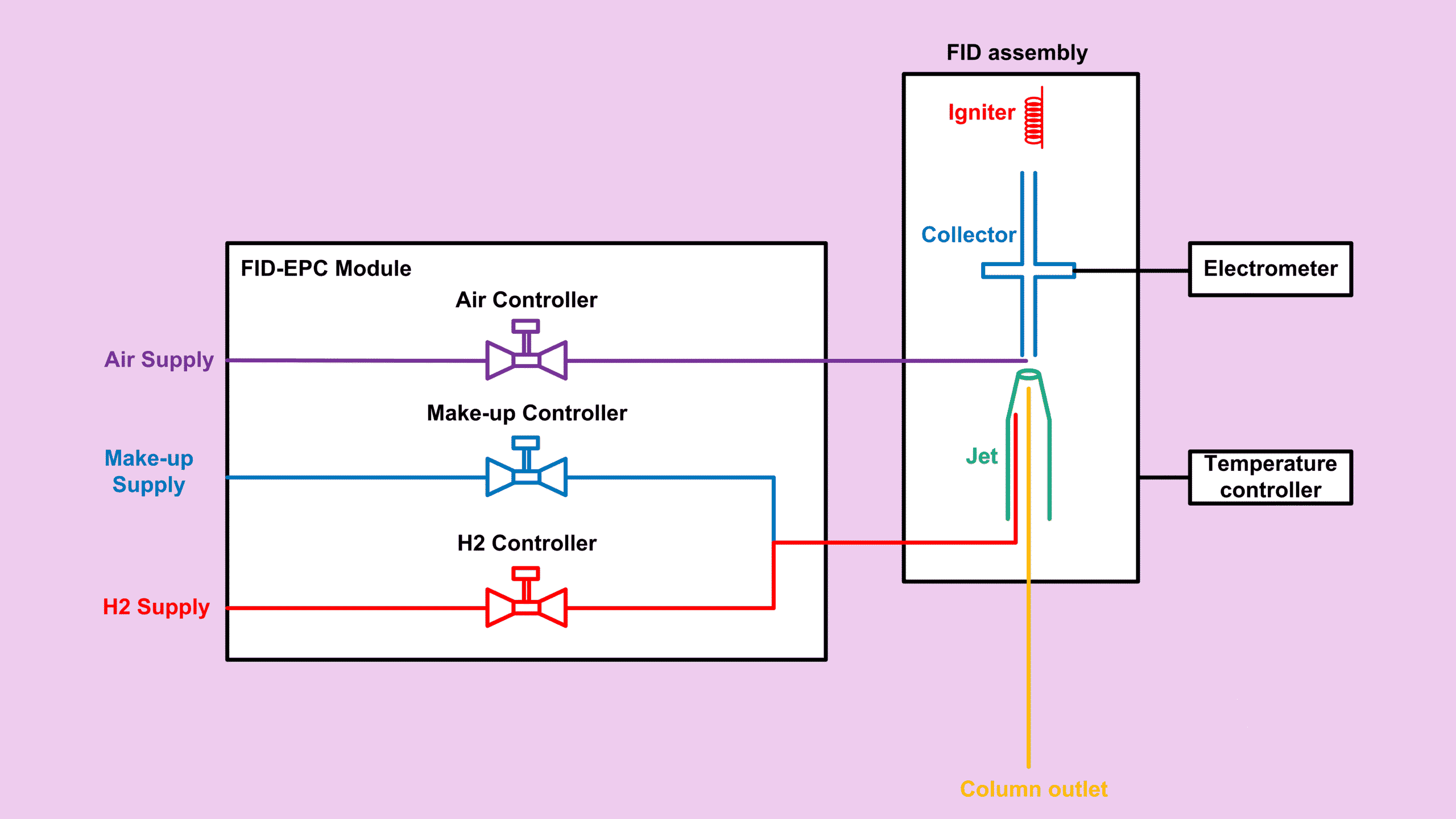

If you’ve been following this FID series, you already understand what relative response factor (RRF) is and how it’s derived. However, many GC users still ask the same question: why should we actually calculate FID RRF?
In this post, we’ll focus on one powerful benefit of how to calculate FID RRF to determine the concentration of an unknown peak instantly. Even better, you’ll have a ready-to-use calculator included, so you can apply it right away.
Before we dive in, just to let you know that this article is part of my Flame Ionization Detector (FID) series which you can find the summary for all other posts related to FID at FID Detector: Complete Guide to the Entire FID Series.
Why Calculate FID RRF for Unknown Peaks?
Imagine this situation.
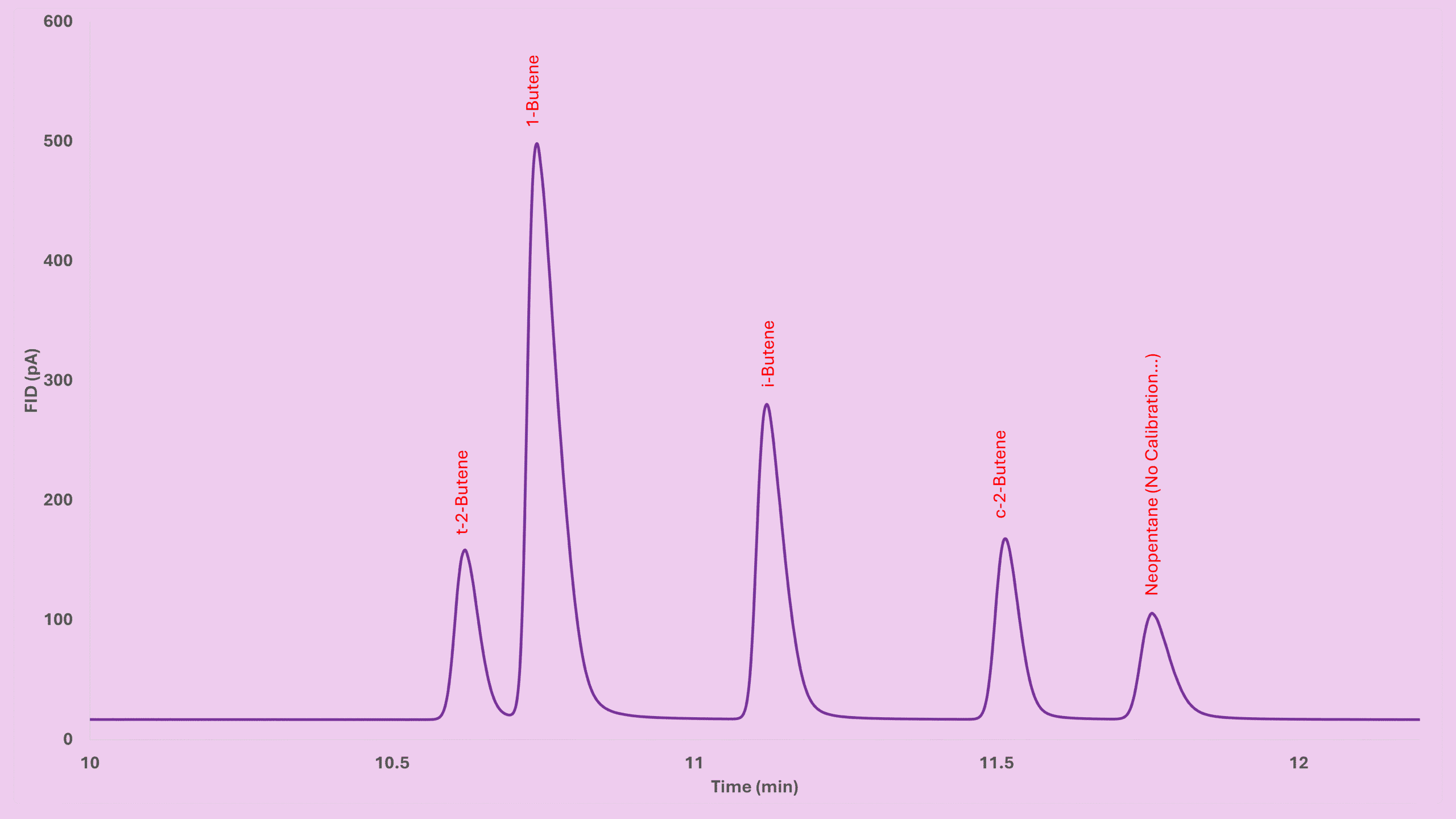
You analyze a sample containing five compounds:
t-2-butene, 1-butene, i-butene, c-2-butene, and neopentane.
Your column performs beautifully and separates all five into distinct peaks. However, the calibration standard only contains the first four compounds — neopentane is missing.
So how do you quantify it?
This is exactly where you need to calculate FID RRF.
Step 1: Calculate FID RRF Using Mole Basis
To simplify the calculation, let’s assume the concentration for all compounds is expressed in mole%. You can, however, apply mass% or volume% if your situation calls for it.
Now let’s take c-2-butene as the reference compound and neopentane as the unknown.
From the theoretical mole-based relationship:
\[ RRF_{Mole}(i/ref) = \frac{C_{ref}}{C_{i}} \]For neopentane relative to c-2-butene:
\[ RRF_{Mole}(neopentane/c2butene) = \frac{4}{5} = 0.8 \]Assume the concentration of c-2-butene in the calibration blend is 0.5 mole%. Analyzing the blend with a GC produces a peak area of 500.
So the response factor of the referenced c-2-butene becomes:
\[ RF_{c2butene} = \frac{0.5}{500} = 0.001 \]Step 2: Derive the Unknown Response Factor
Recall the RRF formula:
\[ RRF(i/ref) = \frac{RF_i}{RF_{ref}} \]Therefore:
\[ RF_{i} = {RRF(i/ref)} \times {RF_{ref}} \]Substituting the values:
\[ RF_{neopentane} = {0.8} \times {0.001} = 0.0008 \]Now you’re ready to calculate FID RRF–based concentration for neopentane.
Step 3 — Calculate Concentration of the Unknown
Now that we know RF of neopentane, assume a sample containing neopentane is analyzed and produces a peak with 200 area counts, we can now calculate the concentration of neopentane:
\[ C_{neopentane} = {RF_{neopentane}} \times {Area_{neopentane}} = 0.0008 \times 200 = 0.16 \]That’s it. Neopentane in the sample is about 0.16 mole%.
That’s how you calculate FID RRF to quantify an unknown compound — even when no calibration standard exists.
General Formula to Calculate FID RRF Concentration
To generalize the formula, we can do as below:
\[ C_{i} = {RF_{i}} \times {A_{i}} \]Replace RFi:
\[ {RF_{i}} = {RRF(i/ref)} \times {RF_{ref}} \]And replace RFref:
\[ {RF_{ref}} = \frac{C_{ref}}{A_{ref}} \]The final formula is:
\[ {C_{i}} = \frac{{RRF(i/ref)} \times {C_{ref}} \times {A_{i}}}{A_{ref}} \]Once you understand this relationship, you no longer depend entirely on multi-component standards.
Use the Calculator to Calculate FID RRF Instantly
To make things easier, I built a calculator that performs everything automatically.
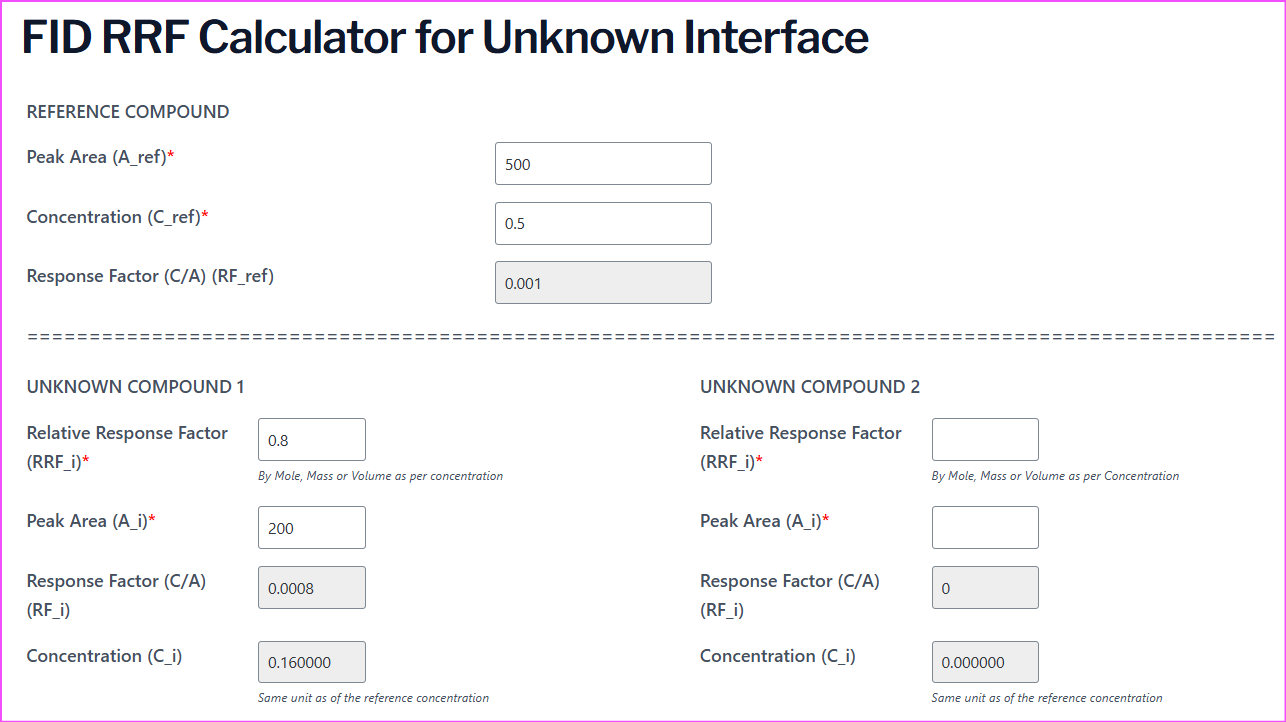
When you enter the same example values, it instantly returns 0.16 mole%.
As a bonus, the calculator allows you to process two unknown compounds simultaneously, which makes routine GC analysis much faster. It’s accessible at FID RRF Calculator for Unknown Peaks.
Key Takeaway
When you calculate FID RRF, you unlock the ability to:
- Quantify unknown compounds
- Avoid preparing additional calibration standards
- Save time during troubleshooting
- Increase confidence in quantitative GC work
Most importantly, you move from simply reading peaks to actually understanding them.
Continue Learning
If this helped clarify how to calculate FID RRF, explore the other related posts below.
- FID RRF Verification: Comparing Theoretical and Experimental RRF
- FID RRF Normalization: Quantifying GC Peaks Without Calibration
- How FID CO CO2 Detection Works Using a Methanizer
If you need to revisit the blog posts related to how FID RRF is deriving, below are the links: