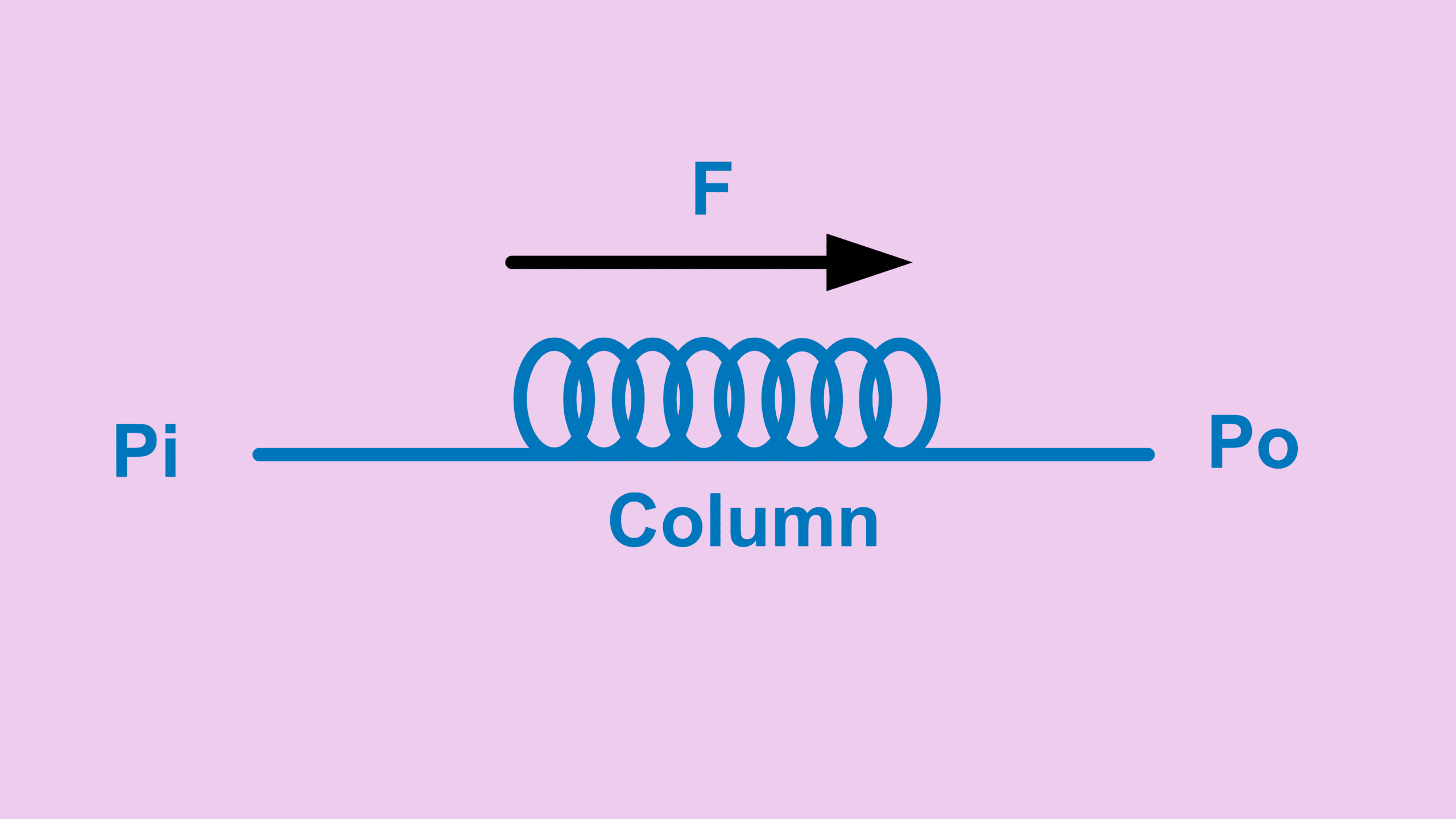

We have previously gone through the flow calculations for single column and 2 columns connected in series. In this post, we will dive into GC column flow series for three columns. Honestly speaking, this configuration is not common. The only case I have personally implemented was when the main analytical column max temperature was not high enough for me to connect it to a MSD interface at 250 °C. As a result, I added a length of fused silica tubing without any stationary phase.
Understanding GC Column Flow Series with 3 Columns
When dealing with such configuration, you may want to know how much flow passes across three columns and what the pressure is at the middle of column 1–2 and 2–3. Therefore, in this post, we will walk through how to find those values step by step.
Foundation Formula for GC Column Flow Series
Again, we will tap on the foundation formulas below:
\[ F_o = C \cdot \frac{\Delta P^2}{R} \]Where:
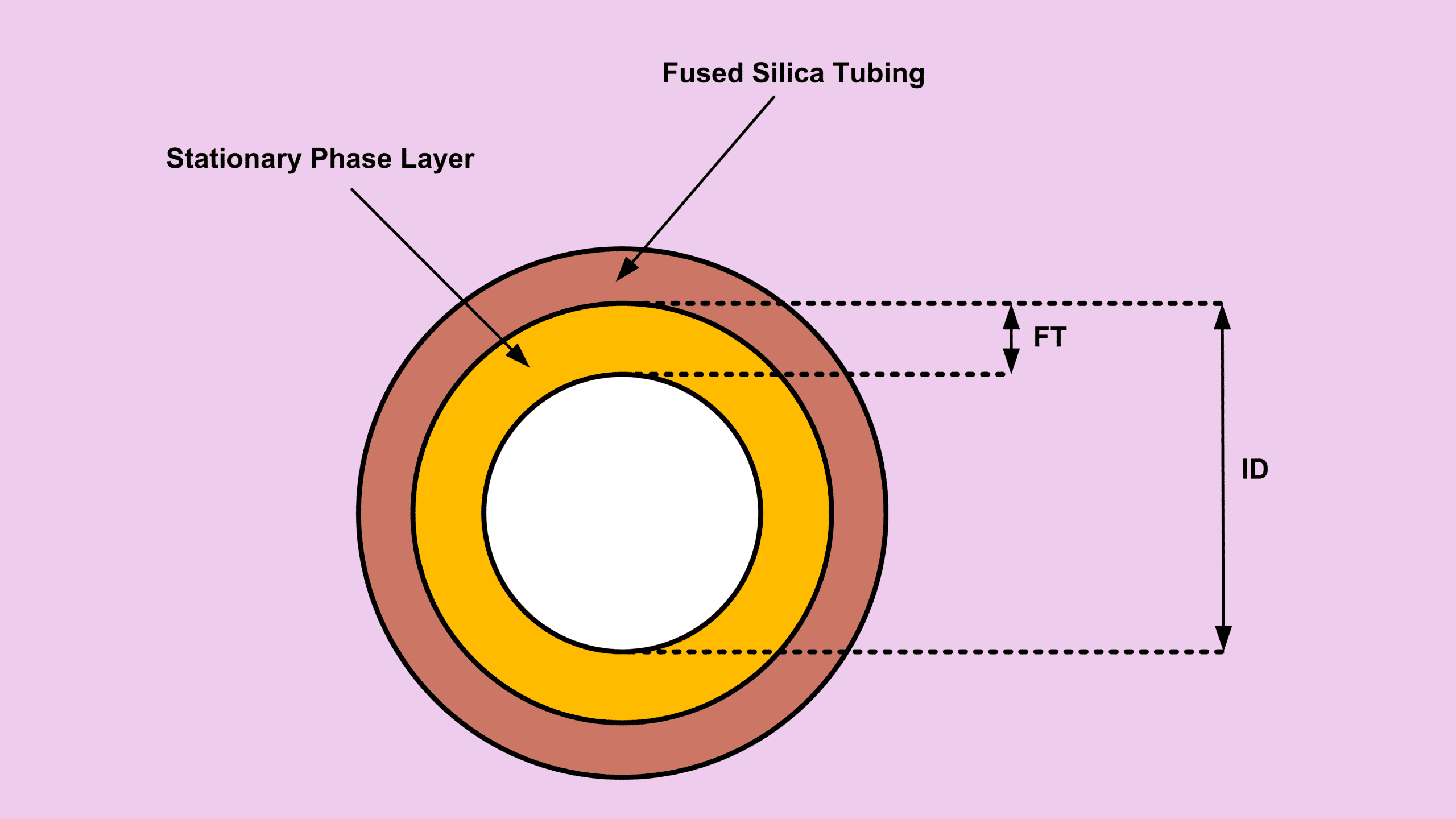
\[ C = 1{,}029{,}546.68 \] \[ \Delta P^2 = P_i^2 – P_o^2 \] \[ R = \frac{\eta L T_c}{d^4} \]Total Resistance in GC Column Flow Series
Instead of solving this by applying the same flow rate across all 3 columns like in earlier posts, we will use another concept similar to circuitry. This makes understanding GC column flow series much more intuitive.
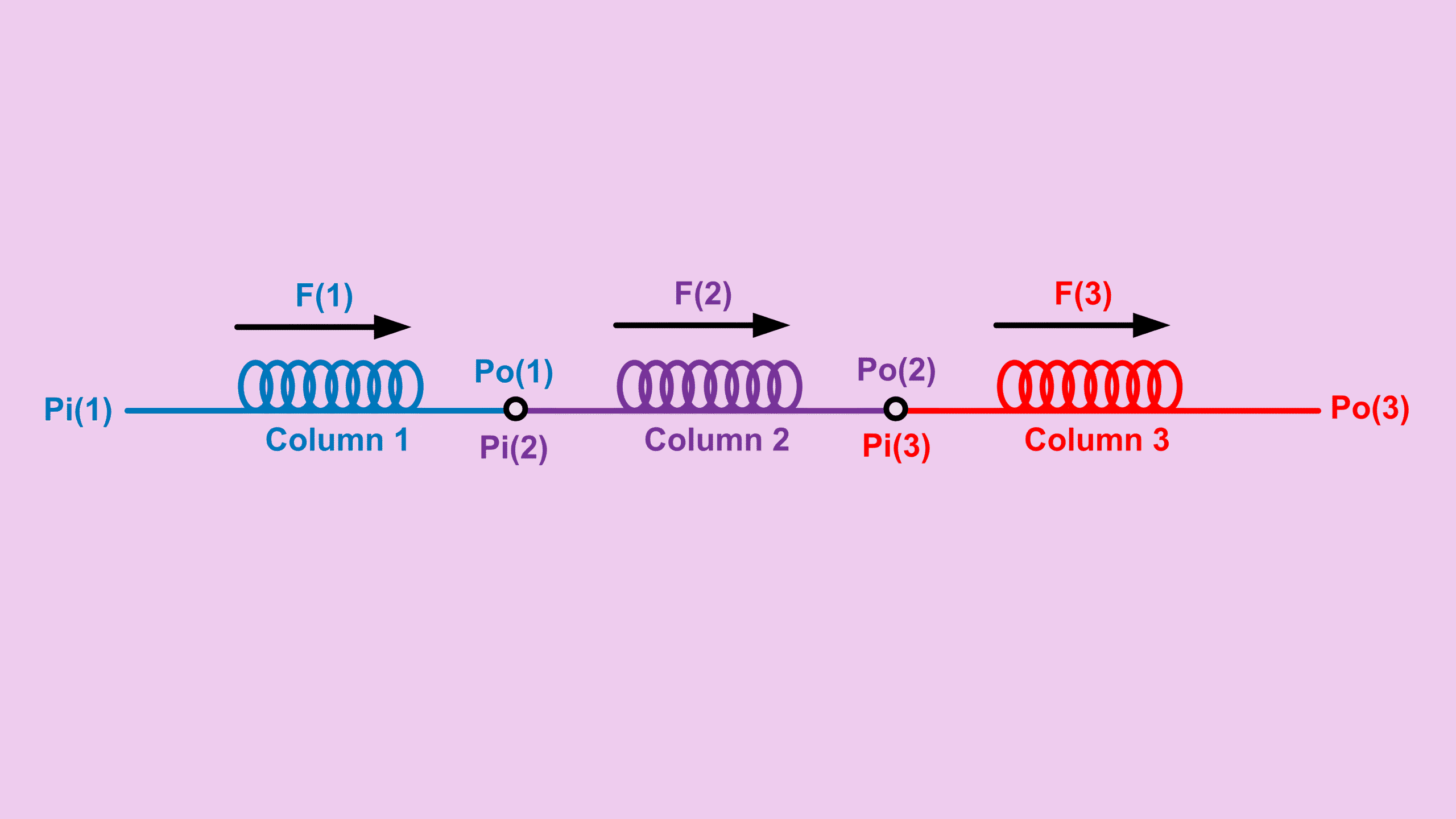
Since three columns are connected in series, the total resistance is simply the sum of each individual column:
\[ R_{\text{total}} = R_1 + R_2 + R_3 \]As we already know the column info for each column, each individual resistance can be calculated easily. After that, the total resistance is straightforward.
Calculating Total Pressure Drop
Now, we know the inlet pressure of column 1 and the outlet pressure of column 3. If we treat the three columns in series just like a single column, we can calculate the total pressure drop:
\[ \Delta P_{\text{total}}^2 = P_{i(1)}^2 – P_{o(3)}^2 \]At this point, both total resistance and total pressure drop are known. Therefore, the total flow can be calculated.
Flow in GC Column Flow Series
\[ F_{\text{total}} = \text{Constant} \times \frac{\Delta P_{\text{total}}^2}{R_{\text{total}}} \]Here is the key insight for this column configuration:
\[ F_{\text{total}} = F_1 = F_2 = F_3 \]In other words, the flow is the same across all three columns.
Finding Mid Pressures Between Columns
Once the flow is known, we can move forward.
First, knowing $F_1$ and $R_1$, we can calculate: $\Delta P_1^2$
With $\Delta P_1^2$ and $P_{i(1)}$ known, we can calculate: $P_{o(1)}$
Note that $P_{o(1)}$ is also equal to $P_{i(2)}$.
Similarly, knowing $F_2$ and $R_2$, we calculate: $\Delta P_2^2$
Then, using $\Delta P_2^2$ and $P_{i(2)}$, we can determine: $P_{o(2)}$
As a result, we can find:
- Flow across each column
- Mid pressure between column 1 and 2
- Mid pressure between column 2 and 3
Using the GC Column Flow Series Calculator
To make things easier, I have combined everything into a calculator:
GC Column 3-Series – Three Capillary Columns
You just need to enter:
- Column 1, 2, and 3 information
- Carrier gas
- Column 1 inlet pressure
- Column 3 outlet pressure
Key Takeaways
- GC column flow series for three columns follows the same physics as simpler setups
- Total resistance is simply the sum of individual resistances
- Flow remains constant across all columns
- Mid pressures can be calculated step by step using known values
Before You Go
If you are working with uncommon configurations like this, understanding GC column flow series can save you a lot of trial and error. It also helps you troubleshoot pressure and flow issues much faster in real systems.
If you are looking for flow calculation in different column connection configurations, check out the posts below:
- Single column → Column Flow Calculation in GC: From Equation to Practical Use
- Two columns in series → GC Column Series Calculation: How Flow and Pressure Work Across Two Columns
- Two columns in series with mid-supply → GC Backflush Column Setup Explained (Flow Calculation Made Simple)
- Three columns in series with mid-supply (1) → GC Series Columns with Midpoint Pressure Supply Calculation