

In this post, let’s dive into column flow calculation and find out the formula to calculate flow across a single capillary column. This will become the foundation of a series about flows when more than one columns are used in your GC.
Understanding Column Flow Calculation from First Principles
First of all, the column flow calculation is based on a well defined formula by Poiseuille equation. It is as below.
\[ Q_2=\frac{\pi R^4 (p_1-p_2)}{8\eta L}\left(\frac{p_1+p_2}{2p_2}\right) \]To modify it into a more GC convention, it becomes this:
\[ F=50747 \cdot \frac{(D-2FT)^4}{\eta L}\cdot \frac{(P_i^2-P_o^2)}{P_o} \cdot \frac{P_o}{P_{ref}} \cdot \frac{T_{ref}}{T_c} \]F: column outlet flow (mL/min)
D: column internal diameter (mm)
FT: column film thickness (mm)
L: column length (m)
Pi: column absolute inlet pressure (psia)
Po: column absolute outlet pressure (psia)
Tc: column temperature (K)
Tref: measured reference temperature (K)
Pref: measured reference pressure (psia)
η: gas viscosity (μP)
| Gas | A | B |
|---|---|---|
| He | 16.5 | 87.8 |
| N₂ | 15.43 | 89.4 |
| H₂ | 7.42 | 39.5 |
| Ar | 12.35 | 62.8 |
Simplifying the Column Flow Calculation Formula
The formula is relatively long so I like to rearrange it into a better format as below.
\[ F=\left(\frac{50747 \cdot T_{ref}}{P_{ref}}\right)\cdot \frac{(P_i^2-P_o^2)}{\left(\frac{\eta L T_c}{d^4}\right)} \]In all my calculations, I use:
- Tref = 25°C
- Pref = 14.696 psia
So the constant becomes:
\[ Constant = \frac{50747 \cdot (25+273.15)}{14.696} = 1,029,546.68 \]Then define:
\[ \Delta P^2 = P_i^2 – P_o^2 \] \[ R = \frac{\eta L T_c}{d^4} \]Finally, it becomes:
\[ F_o = Constant \cdot \frac{\Delta P^2}{R} \]Visualizing Column Flow Calculation Like an Electrical Circuit
So, think of this final column flow calculation formula as an electrical circuit. The top part represents the voltage difference across the circuit, while the bottom part represents the resistance of the circuit.
As a result, the 3 items (F, R and ΔP²) are related and can be calculated as long as 2 factors are known.
From Flow to Velocity
Once Fo is known in mL/min, we can convert it to column outlet velocity (uo) by dividing Fo by the column cross-sectional area.
\[ Area = \pi \times (\frac{D-2FT}{2})^2 \] \[ u_o = \frac{F_o}{Area} \]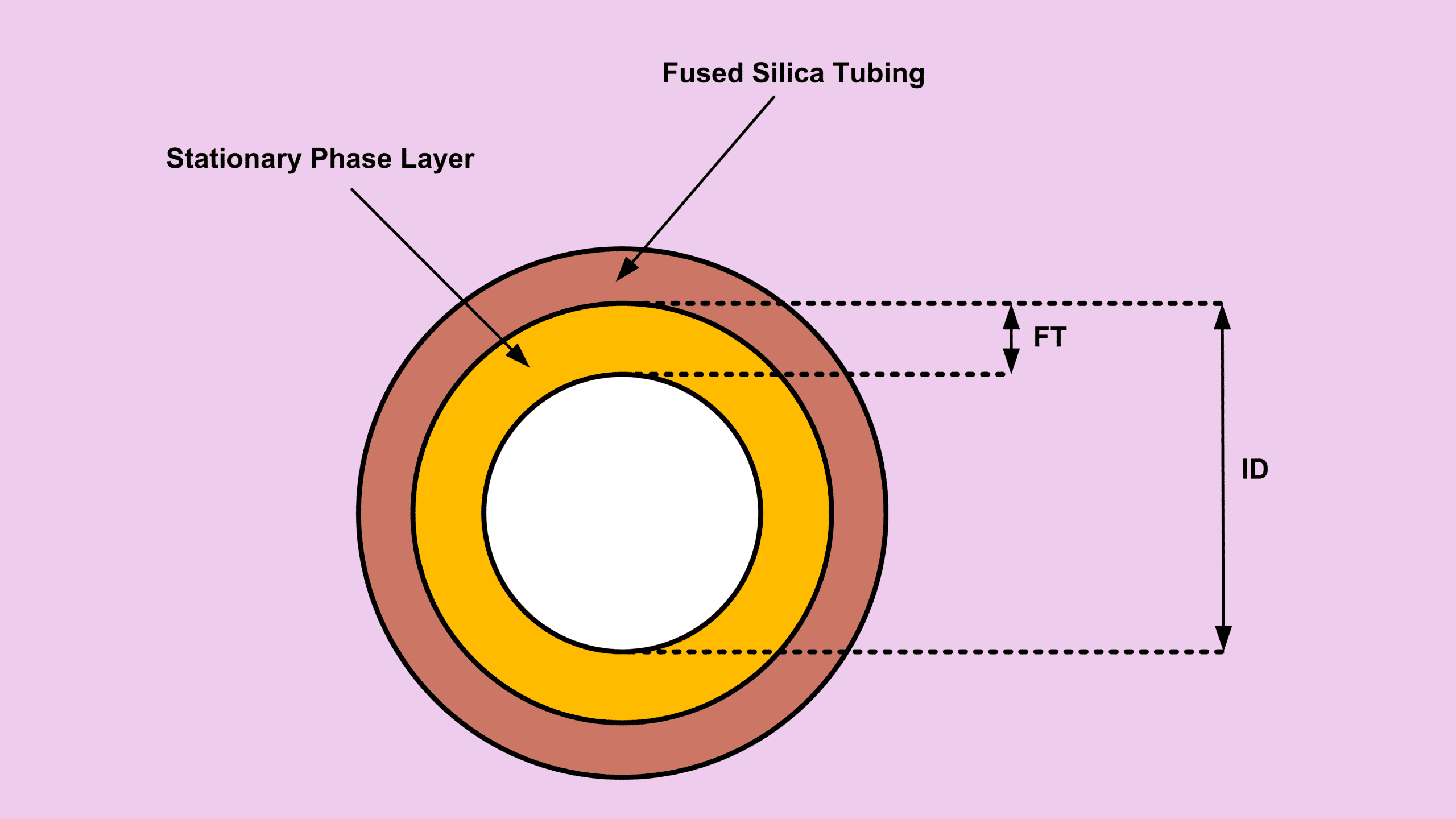
Note that you may need to do some unit conversion to express uo as cm/s. To avoid too much formula in this post, I will not do that here. Instead, I have already built a calculator (GC Column Flow Calculator) which calculates everything.
Why Average Velocity Matters in Column Flow Calculation
You may notice above that I put Fo and uo as outlet flow. However, in chromatography, we are more interested in average velocity (uave) as it directly impacts separation.
As described by Jan Van Deemter, average velocity plays a critical role in efficiency.
To convert from outlet velocity to average velocity, John V. Hinshaw introduced a factor called compressibility (j factor).
\[ j = 1.5 \cdot \frac{\left(\frac{P_i}{P_o}\right)^2 – 1}{\left(\frac{P_i}{P_o}\right)^3 – 1} \]Pi: column absolute inlet pressure (psia)
Po: column absolute outlet pressure (psia)
Finally:
\[ u_{ave} = u_o \cdot j \]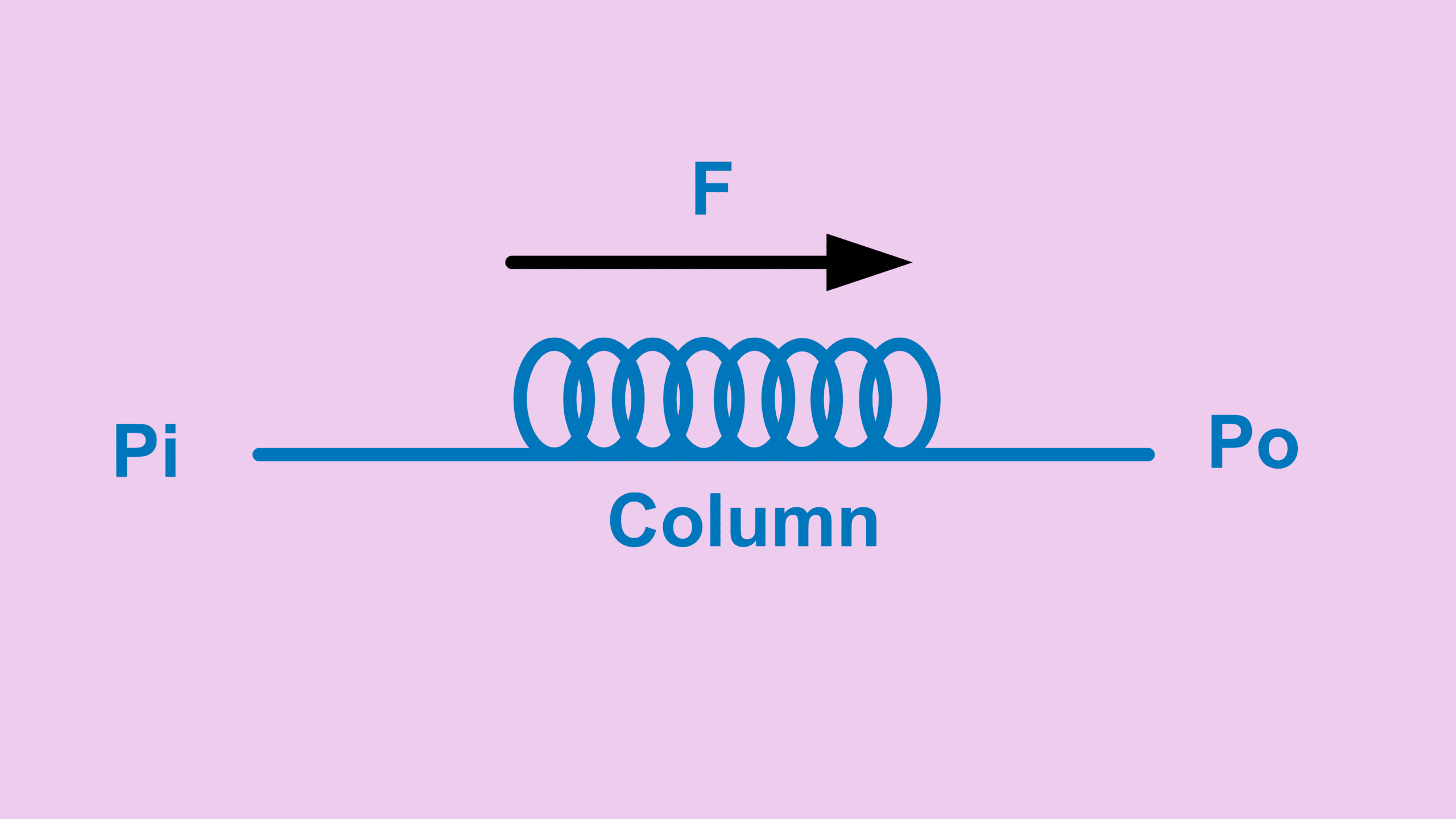
Connecting Column Flow Calculation to Hold-Up Time
This post now explains why I said earlier in this post (Average Linear Gas Velocity in GC: What It Means and How to Use It) that average velocity can be calculated.
The good thing about calculating uave is that you can now also calculate column hold-up time:
\[ t_M = \frac{L}{u_{ave}} \]Again, you may need to do unit conversions first but I recommend just using my calculator on my site instead.
Practical Limitation in Column Flow Calculation
Another thing to note is that in the formula for compressibility above, when Po is approaching vacuum (for example when the column ends with an MSD), the accuracy of the calculation worsens.
So I recommend using this average calculation when the column outlet is at ambient only (14.696 psia).
Key Takeaways
- Column flow calculation starts from Poiseuille’s equation but can be simplified for GC use
- Rearranging the formula helps visualize it like an electrical system
- Flow, pressure difference, and resistance are tightly connected
- Average velocity (uave) is more important than outlet velocity for separation
- Compressibility (j factor) is essential for accurate velocity estimation
Ready to Apply It?
If you want to skip manual calculations, I’ve already built a GC Column Flow Calculator that handles everything — from flow to velocity and hold-up time.
Give it a try and see how your method parameters impact your separation.
You can also check the related post about:
- Two columns in series → GC Column Series Calculation: How Flow and Pressure Work Across Two Columns
- Three columns in series → GC Column Flow Series for 3 Columns Explained
- Two columns in series with mid-supply → GC Backflush Column Setup Explained (Flow Calculation Made Simple)
- Three columns in series with mid-supply (1) → GC Series Columns with Midpoint Pressure Supply Calculation