
When working with GC column series calculation, most people are familiar with a single column setup. However, once you start connecting two columns in series, things get a bit more interesting—and much more useful in certain applications.
While a single column configuration is still the most common in laboratories, using two columns in series brings some clear advantages that are worth understanding.
Why Use Two Columns in Series?
Connecting two columns in series takes your setup to another level. In many cases, a pre-column is installed before the analytical column—and this comes with several benefits.
First, the pre-column helps filter out heavy components in the sample. As a result, the analytical column stays cleaner and lasts longer.
Second, if your analytical column has a small internal diameter, your injection volume is naturally limited. However, by adding a large bore pre-column (e.g., 0.53 mm), you can significantly improve the sample injection capacity.
Finally, the pre-column can have a different stationary phase from the analytical column. This setup is actually used in ASTM D6730 to improve difficult separations such as:
- Toluene / 2,3,3-Trimethylpentane
- p-Xylene / 2,3-dimethylheptane
What Do We Want to Calculate?
When dealing with GC column series calculation, two key questions usually come up:
- What is the flow through both columns?
- What is the pressure at the connection point between the two columns?
In this post, we’ll walk through how to answer both.
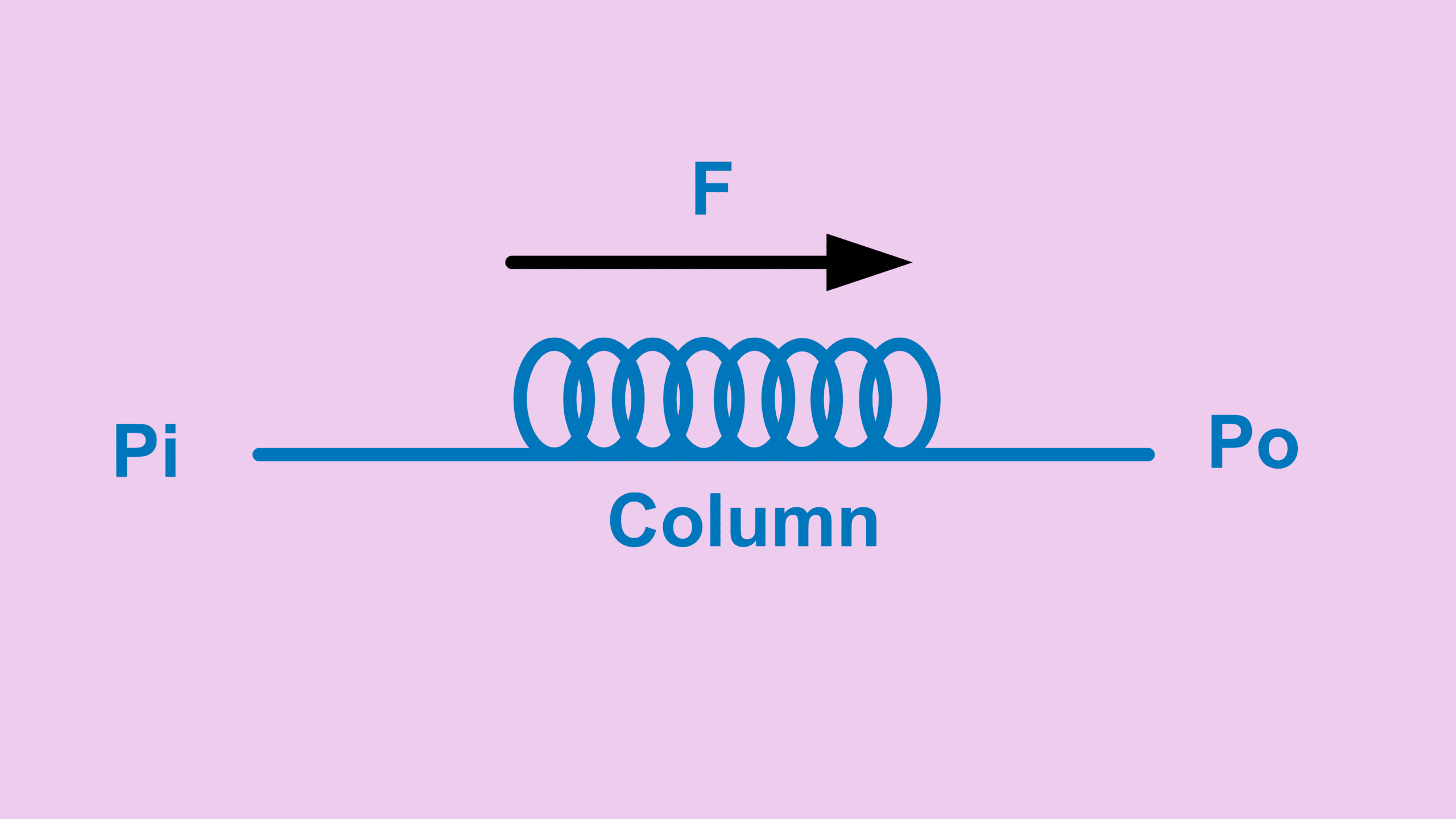
Quick Reminder: Single Column Flow
Before diving deeper into GC column series calculation, let’s quickly recall the equation used for a single column (covered in the earlier post).
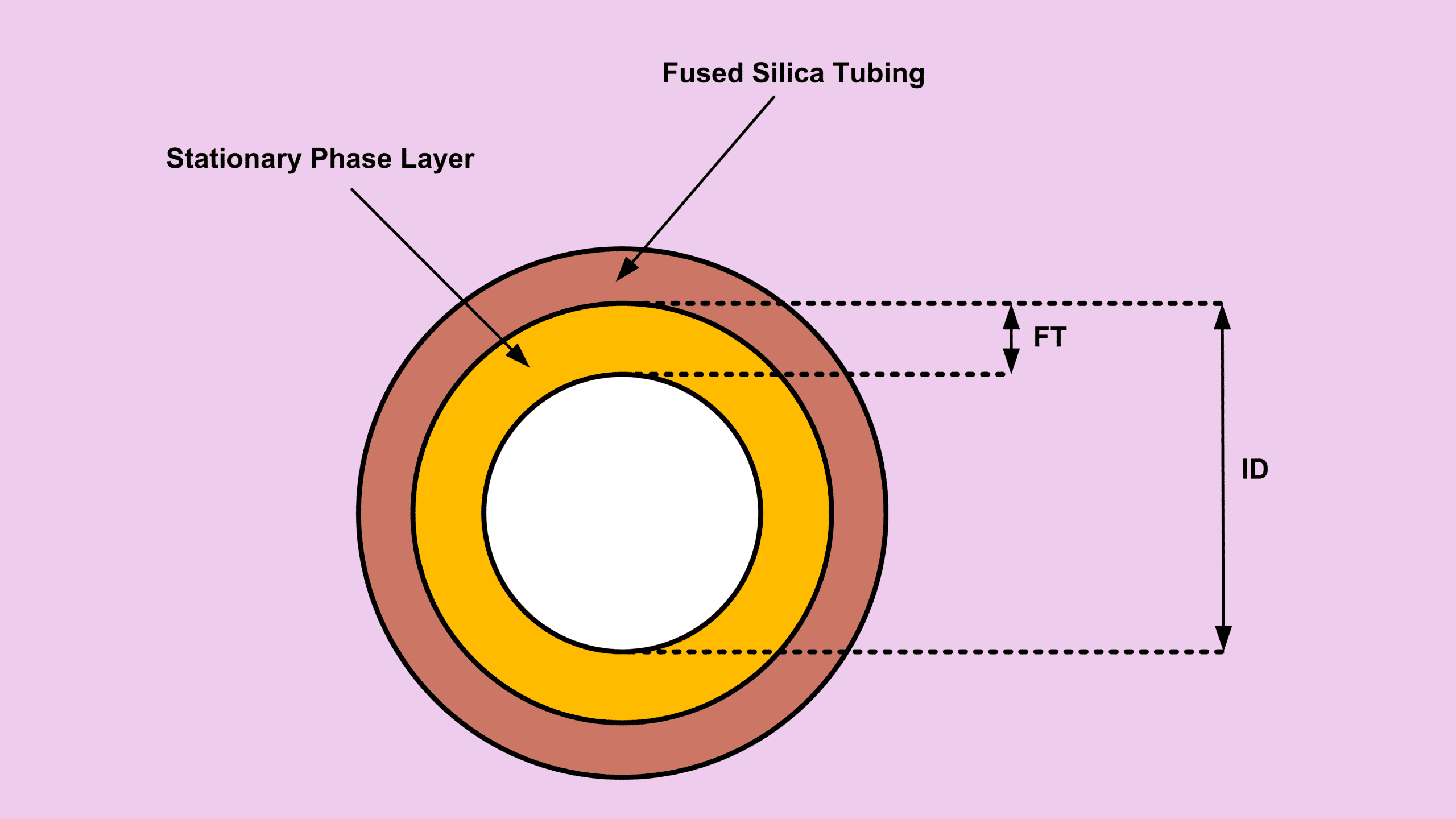
\[ F_o = Constant \cdot \frac{\Delta P^2}{R} \]Where:
\[ Constant = 1{,}029{,}546.68 \] \[ \Delta P^2 = P_i^2 – P_o^2 \] \[ R = \frac{\eta L T_c}{d^4} \]This formula will be reused for both columns in the series setup.
GC Column Series Calculation: Two Columns
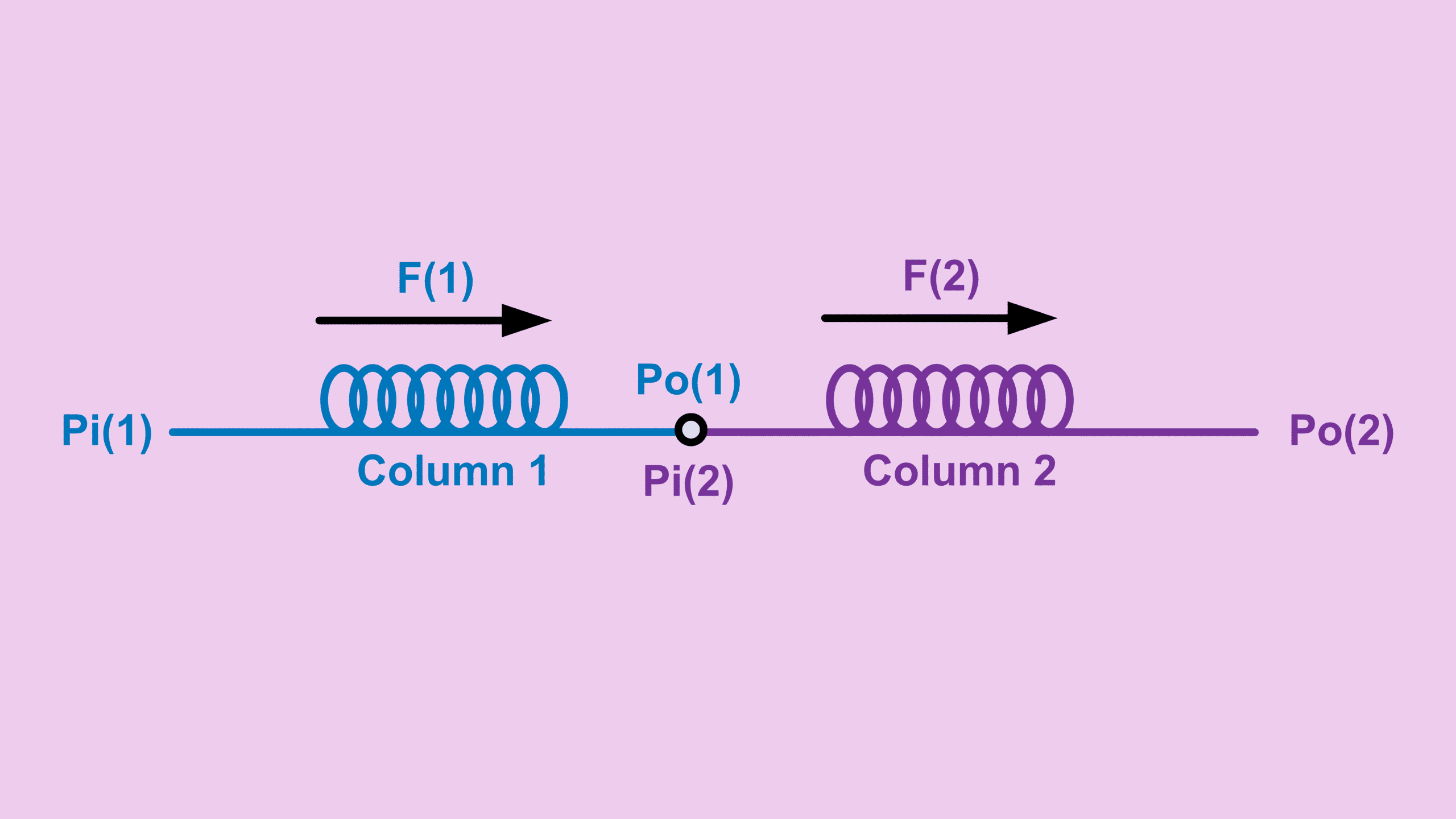
Looking at the configuration, we can define the flow for each column:
\[ F_1 = Constant \cdot \frac{\Delta P_1^2}{R_1} \] \[ F_2 = Constant \cdot \frac{\Delta P_2^2}{R_2} \]Since the columns are connected in series, the flow must be equal:
\[ F_1 = F_2 \]This gives:
\[ C \cdot \frac{\Delta P_1^2}{R_1} = C \cdot \frac{\Delta P_2^2}{R_2} \] \[ \frac{\Delta P_1^2}{R_1} = \frac{\Delta P_2^2}{R_2} \] \[ \frac{\Delta P_1^2}{\Delta P_2^2} = \frac{R_1}{R_2} \]Expanding further:
\[ \frac{P_{i(1)}^2 – P_{o(1)}^2}{P_{i(2)}^2 – P_{o(2)}^2} = \frac{\frac{\eta_1 L_1 T_{c(1)}}{d_1^4}}{\frac{\eta_2 L_2 T_{c(2)}}{d_2^4}} \]Solving the Unknowns
Now, here’s where GC column series calculation becomes practical.
We already know:
- η, L, Tc, d for both columns
- Inlet pressure of column 1 → Pi(1)
- Outlet pressure of column 2 → Po(2)
The only unknowns are:
- Po(1) (outlet pressure of column 1)
- Pi(2) (inlet pressure of column 2)
However, these are actually the same point—the connection between the two columns.
Once you solve for this shared pressure:
- You can calculate ΔP1 → then get F₁
- You can calculate ΔP2 → then get F₂
And since they are equal, you now know the flow through the entire system.
Use the Calculator Instead
Now that the theory behind GC column series calculation is clear, there’s no need to solve this manually every time.
I’ve already combined all these formulas into a practical calculator:
👉 GC Column Series Flow – Two Capillary Columns
You just need to enter:
- Column 1 parameters
- Column 2 parameters
- Carrier gas
- Column 1 inlet pressure
- Column 2 outlet pressure
And you’ll get both the flow and the mid-point pressure instantly.
Key Takeaways
- GC column series calculation helps determine flow and pressure across two connected columns
- The flow is identical in both columns since they are in series
- The connection pressure is the key unknown to solve
- Once that is known, everything else becomes straightforward
Try It Yourself
If you’re working with pre-columns or complex separations, understanding GC column series calculation can save you a lot of trial and error.
Give the calculator a try and see how your setup behaves before running actual samples.
If you are looking for flow calculation in different column connection configurations, check out the posts below:
- Single column → Column Flow Calculation in GC: From Equation to Practical Use
- Three columns in series → GC Column Flow Series for 3 Columns Explained
- Two columns in series with mid-supply → GC Backflush Column Setup Explained (Flow Calculation Made Simple)
- Three columns in series with mid-supply (1) → GC Series Columns with Midpoint Pressure Supply Calculation