
If you’ve been working with gas chromatography for a while, GC retention factor calculation is probably one of the simplest concepts you’ll come across. However, simple doesn’t mean useless — in fact, it’s one of the fastest ways to understand how strongly your analyte interacts with the column.
What is GC Retention Factor Calculation?
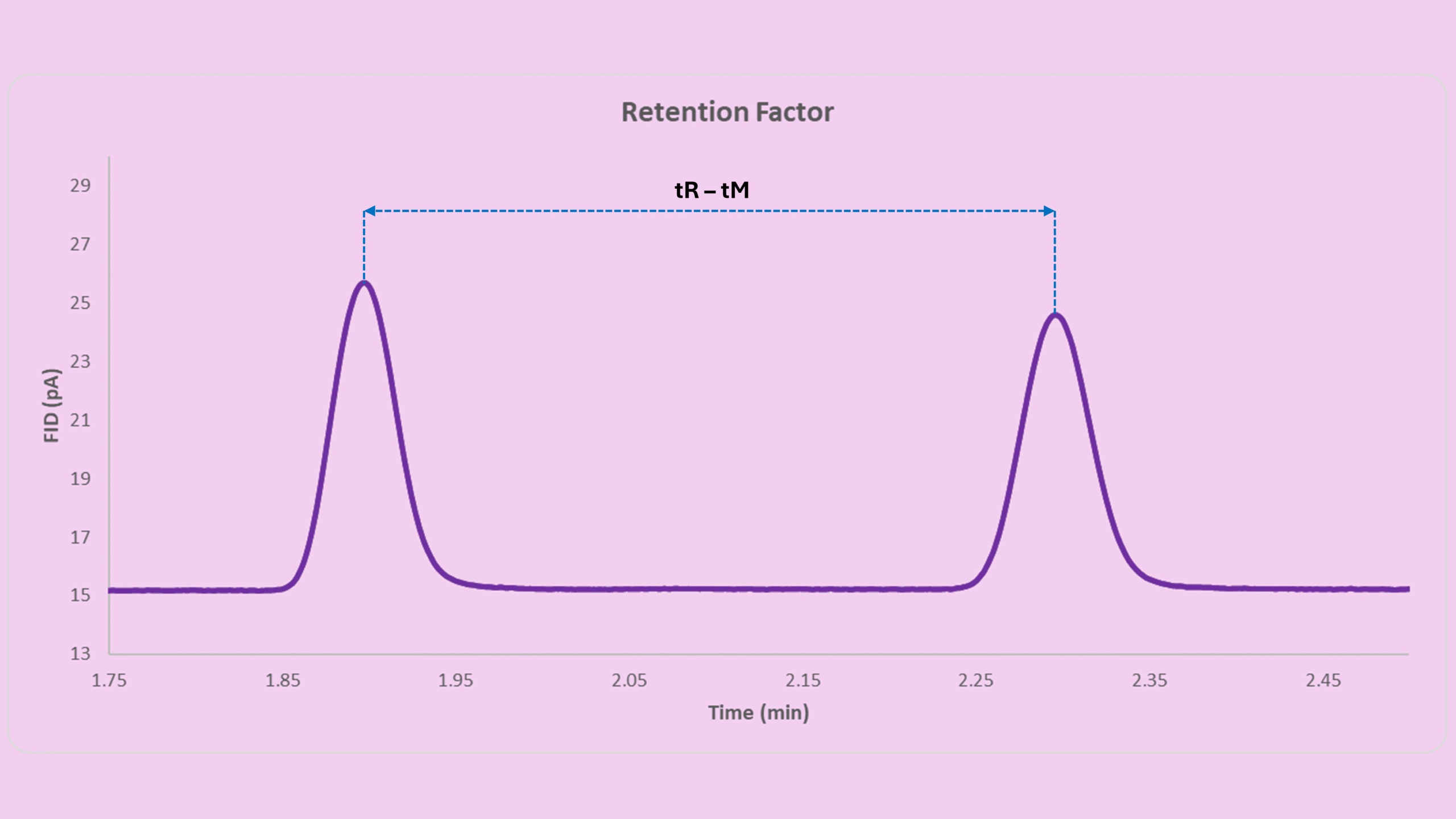
The retention factor, often written as k, tells you how long a compound is retained in the column relative to an unretained compound. Therefore, retention factor gives you a quick way to judge whether your method is behaving properly.
In simple terms:
- If k is small → the compound barely interacts with the column
- If k is large → the compound is strongly retained
GC Retention Factor Calculation Formula
The GC retention factor is based on the following formula:
$$
k = \frac{t_R – t_M}{t_M}
$$
Where:
- tR = retention time of your analyte
- tM = column hold-up time (also called dead time)
Because of this, getting an accurate tM is critical for reliable GC retention factor calculation.
Measuring Column Hold-Up Time (tM) for GC Retention Factor Calculation
Although column hold-up time can be calculated theoretically, I personally prefer to measure it rather than calculate it. In most cases, the experimental approach is more practical and reliable. However, if there is no good way to measure it, then calculation can still be used.
In this post, I’ll focus only on the measuring method, while the calculation method will be covered separately.
By definition, column hold-up time is the time required for an analyte with zero interaction with the column to pass through it under your current conditions (temperature, pressure, flow, etc.).
A common example is methane, which behaves as a non-retained compound in many GC applications.
How to Determine tM (Quick Method)
The process is very straightforward, so you can apply it immediately during your routine work:
- Inject a sample containing methane (or another non-retained compound)
- Identify the methane peak in your chromatogram
- Record its retention time
- Use that value as your column hold-up time (tM)
Why GC Retention Factor Calculation Matters
Even though it’s simple, GC retention factor calculation is extremely useful. For example, it helps you quickly evaluate:
- Whether your separation is within a good working range
- If peaks are eluting too early (k too small)
- If your method is taking too long (k too large)
In practice, a k value between ~1 and 10 is generally considered a good working range. Therefore, checking k regularly can act as a quick sanity check for your method.
Quick Way to Do GC Retention Factor Calculation
If you don’t want to calculate manually, you can use this simple tool:
Just enter your retention time and hold-up time, and the GC retention factor calculation will be done instantly.
Key Takeaways
- GC retention factor calculation helps you understand analyte interaction quickly
- Measuring tM is often more reliable than calculating it
- Methane is commonly used as a non-retained compound
- A k value between 1 and 10 is typically a good target
- It serves as a fast and practical method check
Try It Yourself
If you’re running GC regularly, try applying GC retention factor calculation to your next chromatogram. You’ll quickly see how useful it is as a simple diagnostic tool. This is one of those parameters that’s easy to overlook, but once you start using it regularly, it becomes a very handy sanity check for your GC method.
Check out other posts about column evaluation below:
- GC Column Characteristics
- Average Linear Gas Velocity in GC: What It Means and How to Use It
- GC Peak Resolution Calculation: What It Really Means in Practice
- GC Peak Skewness Explained Simply
- Number of Theoretical Plates Explained in Gas Chromatography
- GC Retention Index Explained Simply
- Retention Index Calculation Made Simple for GC Users