
In this post, we will dive into another concept related to column performance — GC retention index. You can think of it this way: if you rely on absolute retention time, even when using the same column, hardware, and method parameters, peaks may still shift when comparing one GC to another. So, if you can switch from retention time to something more predictable and reusable across different GC platforms, that would be extremely helpful. This is exactly where GC retention index comes in.
What Is GC Retention Index?
The retention index of a compound tells us its relative position compared to two reference compounds, usually n-paraffins.
By convention:
- Methane = 100
- Ethane = 200
- n-Pentadecane = 1500
So, for example, if a compound has a retention index of 433, it elutes between n-Butane and n-Pentane.
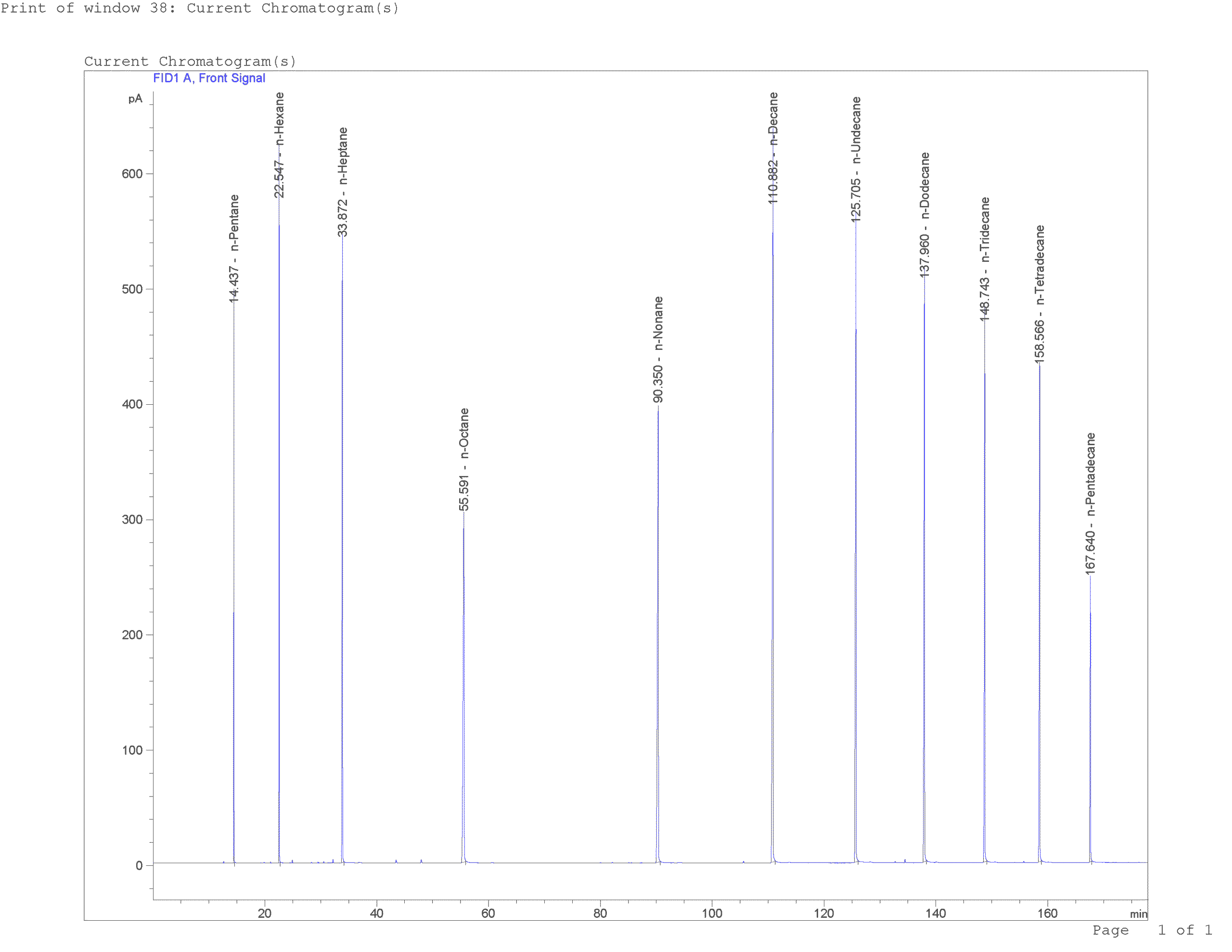
However, keep in mind that retention index is not a fixed constant. It changes depending on the column. Therefore, when checking a value, always make sure the column phase matches.
One reliable reference for retention index data is the NIST library. For instance, the figure below shows where Divinylbenzene elutes.
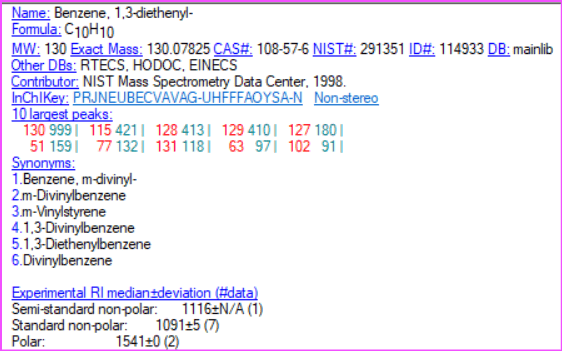
On a standard non-polar column (such as DB-1), Divinylbenzene has a retention index of 1091. Therefore, it elutes between n-Decane and n-Undecane, slightly closer to n-Undecane.
GC Retention Index Formula (Isothermal Conditions)
Now let’s move to how we actually calculate GC retention index.
This is based on a key assumption:
Retention of n-alkanes increases in a predictable, near-linear way with carbon number. Therefore, we can interpolate the analyte position.
For isothermal or near-isothermal methods (like ASTM D6729 or ASTM D6730), the logarithm of retention time is proportional to carbon number.
For an unknown compound:
\[ \lg(t_{i}) = \text{slope} \times n_{i} + \text{intercept} \]For the 1st n-paraffin reference:
\[ \lg(t_{1}) = \text{slope} \times n_{1} + \text{intercept} \]For the 2nd n-paraffin reference:
\[ \lg(t_{2}) = \text{slope} \times n_{2} + \text{intercept} \]From there, we derive:
\[ \text{slope} = \frac{\lg(t_2) – \lg(t_1)}{n_2 – n_1} \]Subtract the 1st reference from the unknown:
\[ \lg(t_{i}) – \lg(t_{1})= \text{slope} \times (n_{i} – n_{1}) \]Rearrange:
\[ n_{i} – n_{1} = \frac{\lg(t_{i}) – \lg(t_{1})} {\text{slope}} \]Replace the slope:
\[ n_{i} – n_{1} = \frac{\lg(t_{i}) – \lg(t_{1})} {\lg(t_{2}) – \lg(t_{1})} \times ({n_2 – n_1}) \]Rearrange:
\[ n_{i} = n_{1} + \frac{\lg(t_{i}) – \lg(t_{1})} {\lg(t_{2}) – \lg(t_{1})} \times ({n_2 – n_1}) \]And finally, the retention index:
\[ RI_{i} = 100 \times n_{i} \] \[ RI_{i} = 100 \times ({n_{1} + \frac{\lg(t_{i}) – \lg(t_{1})} {\lg(t_{2}) – \lg(t_{1})} \times ({n_2 – n_1})}) \]If the two reference compounds are adjacent (such as ASTM D6730):
\[ n_{2}-n_{1}=1 \]RI is simplified to the core formula in textbooks.
\[ RI_{i} = 100 \times ({n_{1} + \frac{\lg(t_{i}) – \lg(t_{1})} {\lg(t_{2}) – \lg(t_{1})} }) \]Converting GC Retention Index Back to Retention Time
Sometimes, you may want to estimate retention time from a known retention index.
Steps:
- Calculate slope and intercept
- Convert RI → n=RI/100
- Calculate:
GC Retention Index for Temperature-Programmed Methods
For temperature-programmed methods, the formula becomes simpler. Instead of using logarithmic retention time, we use absolute retention time:
\[ RI_{i} = 100 \times ({n_{1} + \frac{t_{i} – t_{1}} {t_{2} – t_{1}} \times ({n_2 – n_1})}) \]Key Takeaways
- GC retention index improves comparability across instruments
- It is based on interpolation between n-paraffins
- It depends on column phase, so matching conditions is critical
- Different formulas apply for isothermal vs programmed methods
Before You Go
That’s quite a few formulas, so I put altogether in this Retention Index Calculator. In the next posts, we’ll explore how to actually use retention index in real applications.
Check out other posts about column evaluation below:
- GC Column Characteristics
- Average Linear Gas Velocity in GC: What It Means and How to Use It
- GC Peak Resolution Calculation: What It Really Means in Practice
- GC Peak Skewness Explained Simply
- Number of Theoretical Plates Explained in Gas Chromatography
- GC Retention Factor Calculation (k) – Simple and Practical Guide
- Retention Index Calculation Made Simple for GC Users